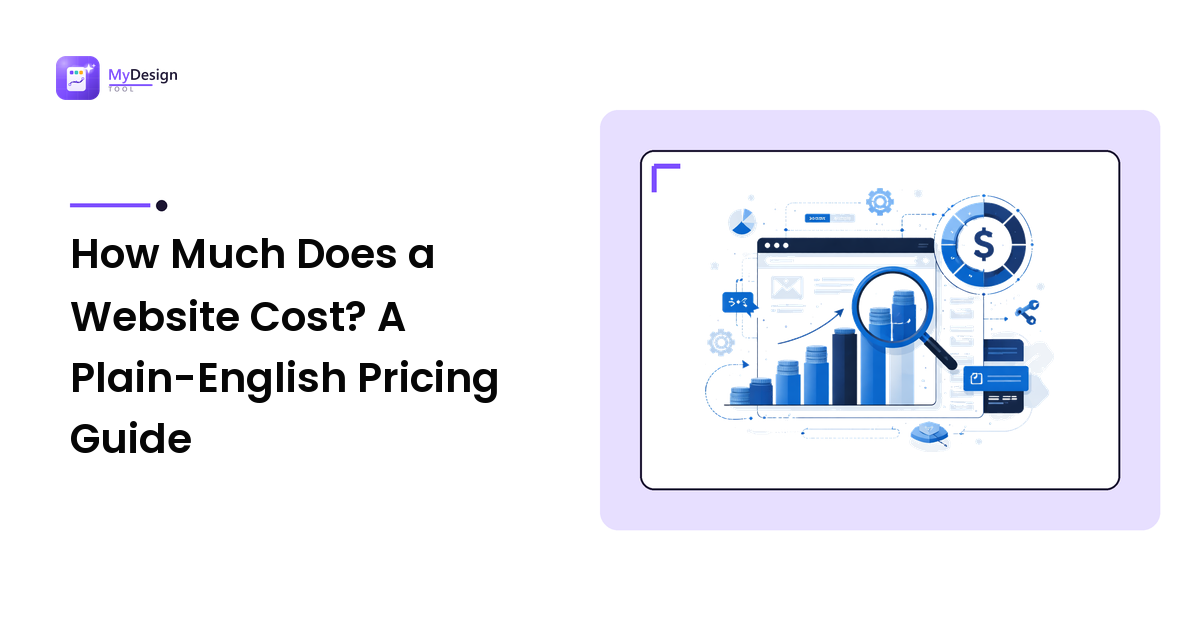
"How much does a website cost?" is one of the most-searched questions in web work, and the honest answer annoys people: it depends. A website can cost almost nothing or run well into six figures, and the price is set by scope — what the site has to do — not by the word "website." A one-page site for a local plumber and a custom booking platform are both "websites," and pricing them the same makes no sense.
So instead of a fake single number, here's what you actually need: the real cost tiers, what each buys, the drivers that move the price, and the ongoing costs almost everyone forgets — enough to size your own project and tell a padded quote from one that's too cheap to be real.
The takeaway up front: most small-business websites cost somewhere between a few hundred and a few tens of thousands of dollars to build, and the single biggest lever on that number is how much of the site is custom. Where you land inside that range depends on the decisions below.
The four ways to get a website built — and what each costs
Almost every website is built one of four ways. The prices below are ballpark ranges, not quotes — they swing with scope, features, and where your team is based (rates across Egypt and the wider MENA region often sit below typical US or Western Europe pricing for comparable work). Use them to place your project, not to hold anyone to a figure.
| Approach | Typical ballpark | Best for | The real trade-off |
|---|---|---|---|
| DIY website builder | Subscription only, roughly $15–$50/mo, plus your time | Solo founders, early validation, tightest budgets | You are the designer and the webmaster; you work inside the builder's limits |
| Template + freelancer | ~$500–$5,000 one-time | Small businesses wanting a polished site quickly | Quality tracks the freelancer; less strategy and hand-holding |
| Professional / agency (custom) | ~$5,000–$40,000+ | Established businesses, custom features, real eCommerce | Higher cost — you're paying for scope, strategy, and support |
| Complex web app / enterprise | $40,000 to six figures+ | Custom platforms, large catalogs, deep integrations | This is a software project, not a "website" |
DIY builders (Wix, Squarespace, Shopify) are cheapest because the build cost is your own hours — the right call when budget is the hard constraint and your needs are standard. A freelancer on a template buys a professional result without agency pricing, though quality tracks whoever you hire. An agency custom build is where price climbs, because you're paying for planning, custom design, testing, and someone accountable after launch — it earns its cost when the site is central to how you win business. A complex web application — a marketplace, a booking system, a large custom store — is genuinely custom software, and six-figure numbers there reflect months of engineering, not padding.
What actually drives the price
Within any tier, the same handful of factors decide where you land:
- Number of pages and content. A five-page site costs a fraction of a fifty-page one. Whether you write the content or the team does moves the number too — copywriting is real work.
- Template versus custom design. This is the biggest single swing in website design cost. A customized template is far cheaper than a design built from scratch, and for most businesses it's the smarter spend. It's worth deciding deliberately rather than by default — our guide on custom website vs template walks through exactly when each is worth it.
- Functionality. A simple informational site is cheap. Add a booking system, a members' area, multi-language support, or anything interactive and cost rises with the complexity of what you're building.
- eCommerce. Selling online adds product pages, a cart, checkout, payment integration, and shipping logic. A store almost always costs more than a comparable content site.
- Integrations. Connecting your CRM, email tool, booking software, or an ERP is engineering work, and each connection adds hours.
- The platform (CMS). Your content management system shapes both build and running cost — how easily you can update the site yourself, and what hosting and upkeep it needs afterward.
Name which of these apply to you and you've roughly scoped your own project.
The costs almost everyone forgets: a website isn't a one-time purchase
The build price is only half the picture. A website is more like a vehicle than a painting — it needs fuel and servicing to stay useful. Budget for these from day one:
- Domain name — roughly $10–$20 a year. Small, but yours to renew forever.
- Hosting — from a few dollars a month for a small site to considerably more for a busy store or web app. This is the recurring cost of keeping the site online, and cheaping out here shows up as a slow site.
- SSL certificate — the padlock in the address bar. Often free (via Let's Encrypt) or bundled with hosting; confirm it's included.
- Maintenance and updates — software updates, security patches, backups, and fixes. On DIY builders this is largely handled for you; on a self-hosted platform it's your responsibility or a monthly retainer.
- Content and changes — new pages, seasonal updates, and tweaks over time, whether you do them or pay someone.
Skip this planning and a "cheap" website gets expensive the moment something breaks and no one owns the fix. A realistic budget is year-one total — the build plus twelve months of running it.
A simple way to budget for your website
You don't need a spreadsheet to get this right. Work through five steps in order:
- Write down what the site must do. Not how it looks — what it accomplishes. "Take bookings," "sell 40 products," "generate enquiries." Function drives cost.
- Split must-haves from nice-to-haves. Be ruthless. Every "would be nice" feature is real money and real time. The smallest site that meets your goal is usually the right first version.
- Pick your tier honestly. Match your needs and budget to one of the four approaches above. Don't buy a custom build for a brochure site, and don't force a DIY builder to run a complex store.
- Budget year one, not just the build. Add hosting, domain, and upkeep to the build price so the number is real.
- Get comparable quotes. Hand the same written scope to every vendor. Quotes are only comparable when they're pricing the same thing.
That written scope is the most valuable thing you can bring to any pricing conversation — it turns a vague "how much for a website?" into a question anyone can answer.
Why two quotes for "a website" can differ tenfold
If one quote is $1,500 and another is $15,000, someone isn't wrong — they're pricing different work. A higher number often (not always) buys custom design instead of a template, strategy before anyone builds, thorough testing, better hosting, and a real person accountable after launch. A lower number often means a lightly-customized template and less support — completely fine if that's what you need.
The mistake is comparing prices without comparing scope. Before you judge a quote, ask what's included: design approach, revisions, who writes the content, what happens after launch, and who owns the site and its code. The red flags cut both ways — a price far below the rest usually hides a catch you'll meet later, and one far above the pack should come with a clear reason for the premium. Judge on scope and fit, never on the number alone.
Frequently asked questions
How much does a website cost for a small business?
Most small-business sites land between a few hundred dollars (a freelancer's template) and the low tens of thousands (a custom agency build). A simple, professional brochure site commonly falls in the low-thousands range once you want it customized and done for you — but the honest figure depends on your page count, features, and whether you're selling online.
Why do website quotes vary so much?
Because "a website" isn't one product. Price tracks scope — template versus custom design, number of pages, functionality, eCommerce, and the level of strategy and support included. A tenfold gap between two quotes usually means they're pricing genuinely different work, which is why a written scope handed to every vendor is the only way to compare fairly.
Is it cheaper to build a website myself?
On upfront cash, yes — a DIY builder replaces labor cost with your time. That's a smart trade when budget is tight and your needs are standard. It stops being cheaper when your time is scarce or the result costs you customers, since a confusing, slow, or unfinished site quietly loses business that a professional build would have kept.
How much does a website cost per month to run?
For a small site, running costs are modest: a domain (a few dollars a year) plus hosting (from a few dollars a month upward), with SSL often free. Add a maintenance retainer or your own time for updates and backups; a busy store or web app costs more. Budget running cost alongside the build — it's ongoing, not optional.
Do I pay for a website once, or every year?
Both. The build is largely one-time, but the domain, hosting, and upkeep recur for as long as the site is live. Treat a website as something you run, not something you buy once — that's what keeps a cheap build from turning expensive later.
Does a more expensive website make more money or rank higher?
Not on its own. Price buys scope and quality, not results — spending more guarantees nothing about traffic or sales. Those are moved by a site that loads fast, is easy to use, and is backed by real marketing. A well-built site removes the obstacles to those outcomes; it doesn't purchase them.
The bottom line
A website costs what its scope costs — anywhere from the price of a subscription to a six-figure software project — and the number is yours to shape by deciding, honestly, what the site actually needs to do. Start from function, cut the nice-to-haves, budget for year one rather than the build alone, and compare quotes against one written scope. Do that and "how much does a website cost?" stops being a mystery and becomes a decision you control.
Write down what your site must do, split the must-haves from the nice-to-haves, and price the smallest build that meets your goals. And remember that the tools you choose — builder, template, or design software — are the biggest lever on that number; MyDesign Tool covers how to pick the ones that fit the job without paying for capability you'll never use.